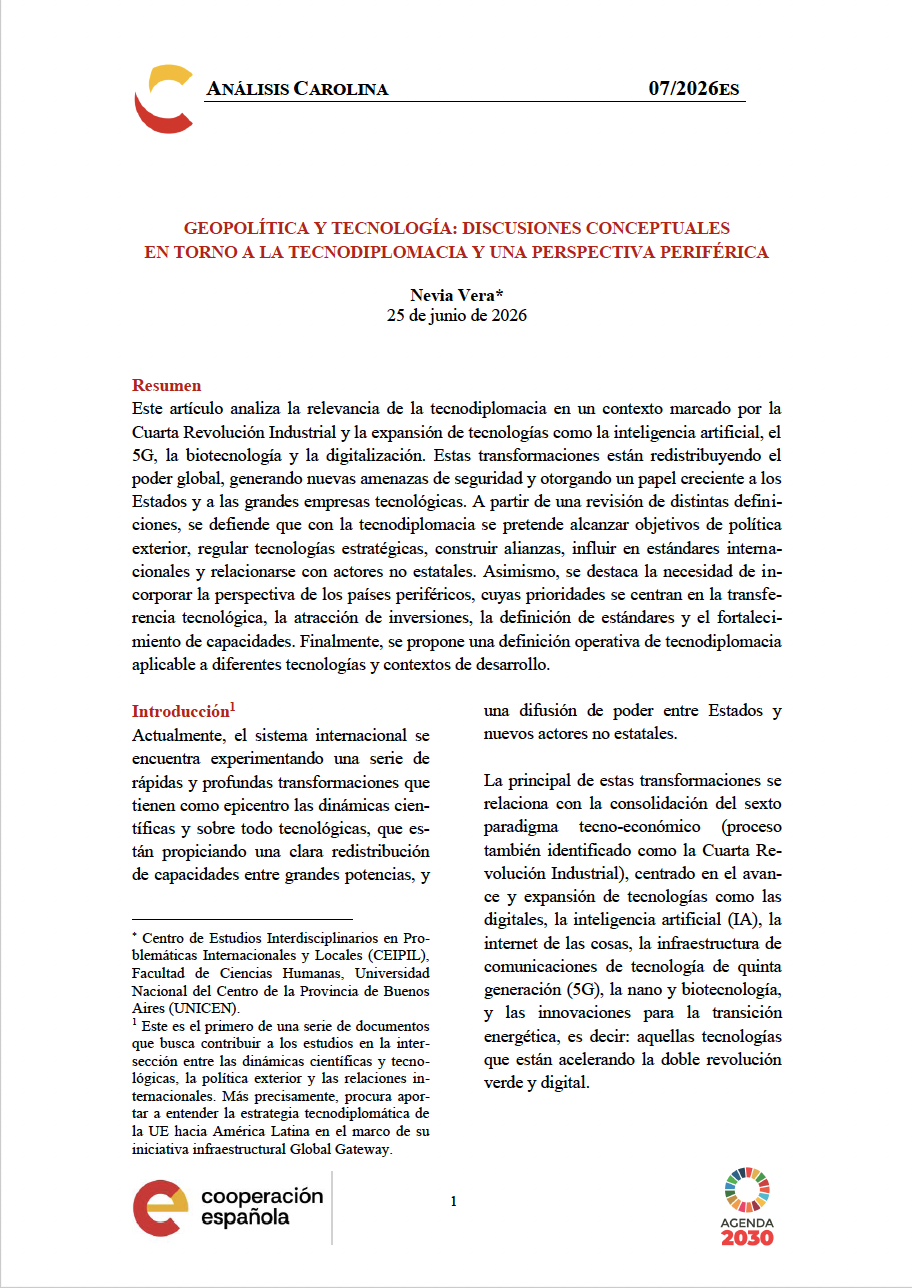


This article examines the relevance of technodiplomacy in a context shaped by the Fourth Industrial Revolution and the expansion of technologies such as artificial intelligence, 5G, biotechnology, and digitalization. These transformations are redistributing global power, generating new security threats, and granting an increasingly prominent role to states and large technology corporations.
Based on a review of different definitions, it is argued that technodiplomacy seeks to achieve foreign policy objectives, regulate strategic technologies, build alliances, influence international standards, and engage with non-state actors.
Furthermore, the article highlights the need to incorporate the perspective of peripheral countries, whose priorities focus on technology transfer, the attraction of investment, the definition of standards, and capacity-building.
Finally, it proposes an operational definition of technodiplomacy applicable to different technologies and development contexts.